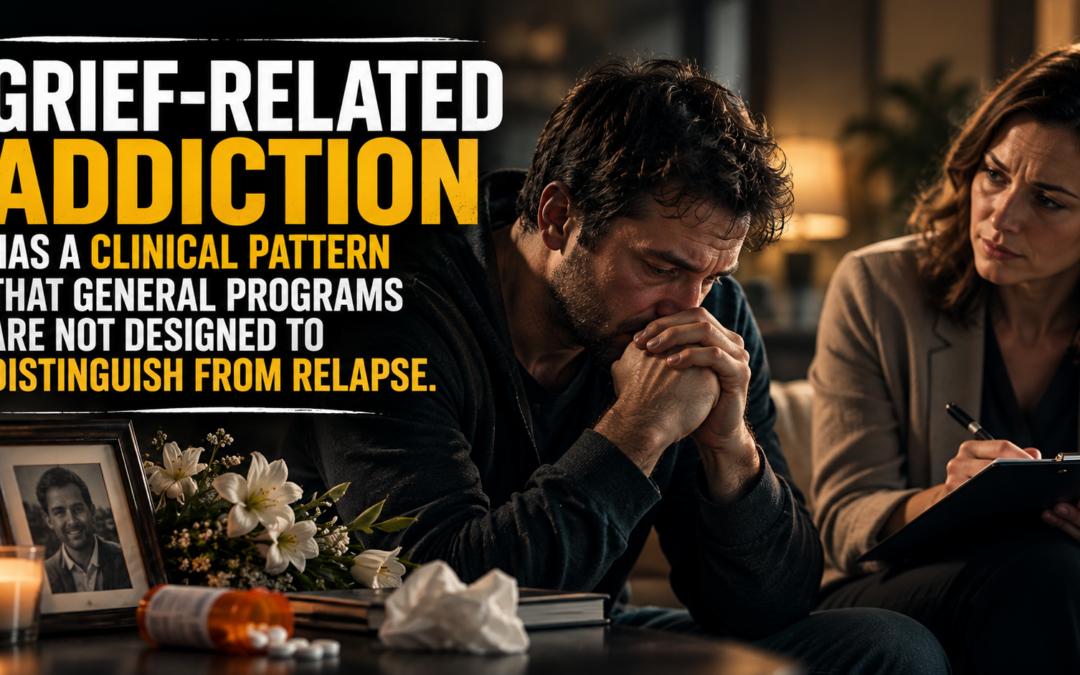
Grief-related addiction often starts quietly in the weeks or months after a death, when alcohol or pills seem to be the only thing that makes the pain bearable. A drink to fall asleep or a pill to get through the funeral can slowly become a daily need. Many people never connect their substance use to the loss at all.
If you’re carrying a loss and a growing reliance on substances, you may feel worn down, guilty or confused. You may have finished treatment, then returned to use near a birthday or anniversary and wondered what went wrong. Those feelings make sense.
This does not mean you failed. Grief has its own rhythm, and it can come back in waves long after the casseroles stop arriving and friends stop checking in. When care recognizes that rhythm, it can respond to what you actually feel instead of treating every hard day as a setback.
What Makes Grief-Related Addiction Clinically Distinct?
Grief-related addiction is clinically distinct because the substance use is tied to a specific loss and tends to rise and fall with grief’s natural waves. Other patterns of addiction may be driven by ongoing stress, social settings or long-standing mental health conditions.
With grief, the substance often serves one clear purpose. It quiets the ache of missing someone.
How Does Grief Change the Purpose of Substance Use?
Grief changes the purpose of substance use by turning it into a way to avoid painful feelings, memories or the reality of the loss. Alcohol may numb sadness. Sleep aids or benzodiazepines may quiet racing thoughts at night.
Over time, the brain learns that the substance brings brief relief. That learned link is what makes grief-related addiction so persistent, even when a person sincerely wants to stop.
What Is Prolonged Grief Disorder?
Prolonged grief disorder is a recognized mental health condition in which intense longing for a loved one disrupts daily life for at least 12 months after the loss in adults. It was added to the Diagnostic and Statistical Manual of Mental Disorders (DSM-5-TR) in 2022.
Not everyone with grief-related addiction meets these criteria. Still, the diagnosis confirms an important truth: some grief is clinical and deserves treatment, not just time.
Why Do General Programs Misread Grief-Related Addiction as Relapse?
General programs misread grief-related addiction as relapse because they are built to track substance use, not the emotional calendar of a loss. When a person returns to use, the program sees a lapse in recovery skills. It may miss the anniversary, holiday or hospital visit that set it off.
Standard relapse prevention focuses on cravings, people and places. Those tools matter, yet they rarely address mourning itself.
What Happens Around Anniversaries and Grief Triggers?
Around anniversaries and other grief triggers, sorrow can return with surprising force. Clinicians often call this an anniversary reaction.
For a person with grief-related addiction, these moments often line up with cravings or a return to use. Tracking that timing helps a clinician see a pattern instead of random setbacks.
Common grief triggers include:
- The anniversary of the death or diagnosis
- Birthdays and holidays once shared
- Clearing out belongings or selling a family home
- Medical settings that recall a final illness
- Milestones the loved one will miss, like weddings or graduations
Why Does a Relapse Label Miss the Point?
A relapse label misses the point because it frames a grief wave as a failure of willpower instead of a sign that the loss still needs care. That framing can deepen shame, which many grieving people already feel.
When treatment names the real driver, the plan can change. Instead of only repeating relapse prevention, care can make room for mourning.
What Are the Warning Signs of Grief-Related Addiction?
The clearest warning sign of grief-related addiction is using alcohol or drugs specifically to avoid feelings or memories connected to a loss. The substance becomes a way to get through the day rather than something enjoyed socially.
Other signs may include:
- Drinking or using to fall asleep since the death
- Use that spikes near anniversaries, holidays or birthdays
- Avoiding the grave, photos or conversations about the person
- Feeling numb, detached or unable to cry
- Taking more of a prescription given during the loss than directed
- Pulling away from family and friends who share the grief
Noticing a few of these is not a diagnosis. It is a reason to ask for a thoughtful assessment.
When Does Grief Become a Safety Concern?
Grief becomes a safety concern when a person talks about wanting to be with the person who died, feels hopeless or begins mixing substances. Combining alcohol with benzodiazepines or opioids raises serious medical risk.
If you or someone you love is thinking about suicide, call or text 988 to reach the 988 Suicide and Crisis Lifeline right away.
How Does Dual-Diagnosis Care Treat Grief-Related Addiction?
Dual-diagnosis care treats grief-related addiction by addressing the loss, any co-occurring mental health condition and the substance use through one coordinated plan. At Grand Falls Center for Recovery, dual-diagnosis treatment brings addiction care and mental health treatment together under one team.
Many losses are also traumatic. A sudden death, an overdose, an accident or a long illness can leave lasting images and fear. Trauma-informed care for grief-related addiction moves gently and puts safety first, before anyone explores painful memories.
What Might Treatment Include?
Treatment often blends grief work, therapy and medical support shaped around your loss. A plan may include:
- Individual therapy that makes space to mourn safely
- Cognitive behavioral therapy (CBT) to ease guilt and unhelpful thought patterns
- Grief-focused relapse prevention that maps anniversaries and triggers
- Group therapy with peers who understand loss
- GeneSight genetic testing to help personalize medication for depression or anxiety when appropriate
GeneSight uses a simple cheek swab to show how your genetics may affect your response to certain medications. This can reduce frustrating trial and error during an already painful season.
How Does Family Therapy Help?
Family therapy helps because grief rarely belongs to just one person. When a family loses someone together, each member may cope differently, and tension can build.
Family therapy gives loved ones space to grieve together, rebuild trust and learn how to support recovery without blame.
What Levels of Care Does Grand Falls Offer for Grief-Related Addiction?
Grand Falls offers a full continuum of care, from medical detox to aftercare, so support can match each stage of recovery. A thorough assessment helps you and your care team choose the right starting point.
- Medical detox provides 24/7 supervised support, which matters most when alcohol or benzodiazepines are involved.
- Residential inpatient treatment offers structured care on a calm, secluded Joplin campus, away from a home filled with reminders.
- Partial hospitalization delivers intensive daytime treatment with evenings at home.
- Intensive outpatient care offers therapy several days a week while you return to work and family.
- Aftercare and alumni support help you stay connected through future anniversaries and milestones.
Aftercare matters especially for grief-related addiction because grief does not follow a treatment calendar. Ongoing support helps you plan for hard dates before they arrive.
How Do You Know Which Next Step Fits?
The clearest sign that grief-informed care may fit is substance use that began or grew after a loss. You don’t need every answer before reaching out.
- If your drinking or drug use started after a death, an assessment can explore whether grief-related addiction is part of the picture.
- If you returned to use near an anniversary or holiday, a program that tracks grief triggers may reach what general care missed.
- If depression, anxiety or trauma followed the loss, dual-diagnosis care can treat them alongside substance use.
- If your home holds constant reminders, residential care can give you space to begin healing.
- If a family member has noticed you pulling away since the loss, that concern is worth exploring together.
Grand Falls offers a free consultation, so you can ask questions and explore options with no pressure.
Common Questions Before Starting Treatment
Is it normal to drink more after someone dies? Many people lean on alcohol or other substances after a loss, especially at first. It becomes a concern when use feels hard to control, keeps growing or replaces other ways of coping. A caring assessment can help you sort out where you are.
Will treatment make me stop grieving? No. Good care does not rush or erase grief. It helps you carry the loss without needing substances to get through each day, and it honors the relationship you lost.
Why did I return to use on my loved one’s birthday? Birthdays and anniversaries often bring grief back with strong force. For people living with grief-related addiction, these dates can trigger intense cravings. Planning for them ahead of time is a core part of grief-informed treatment.
Can my family be part of treatment? Yes. Family therapy helps loved ones grieve together and learn how to support recovery in healthy ways.
Moving Forward With Hope
Grief-related addiction is not a sign that you loved too much or coped the wrong way. It is a recognizable clinical pattern, and it responds best to care that sees the loss behind the substance use.
With dual-diagnosis treatment, trauma-informed therapy and steady aftercare, hard dates can become more manageable over time. You can honor the person you lost while building a healthier future.
You do not have to walk through this alone. If you or someone you love is ready, reach out to Grand Falls Center for Recovery today. Our compassionate team is here to listen, answer your questions and help you take the next step.