Prescription drug misuse often begins in a doctor’s office, with a medication given for real pain, anxiety or trouble focusing. You followed the instructions and trusted the person who wrote the prescription. Then, slowly, the medication started to feel less like treatment and more like something you needed to get through the day.
If you see yourself or a loved one in that story, you may feel confused, embarrassed or even betrayed by your own body. Those feelings make sense. Many people never expected that a pill from the pharmacy could lead somewhere they did not want to go.
This is not a moral failing. Medications that ease pain or calm the mind work directly on the brain, and the brain adapts over time. With honest information and the right support, you can understand what happened and find a safer way forward.
What Is Prescription Drug Misuse?
Prescription drug misuse means taking a medication in any way other than how it was prescribed. This includes taking more, taking it more often or using it for the way it makes you feel. It also includes taking someone else’s prescription, even with good intentions.
Many people misuse medication without realizing it. Taking an extra pill on a bad pain day or borrowing a spouse’s sleep aid can seem harmless in the moment. Prescription drug misuse can affect anyone, from teens who take a parent’s pills to older adults managing several medications.
Which Medications Are Most Often Misused?
The medications most often misused fall into three groups: opioid pain relievers, central nervous system depressants and stimulants. Each one affects the brain in a different way.
- Opioid pain relievers such as oxycodone, hydrocodone and codeine, often prescribed after surgery or injury
- Benzodiazepines and sleep medications such as alprazolam (Xanax), lorazepam (Ativan) and zolpidem (Ambien), prescribed for anxiety or insomnia
- Stimulants such as amphetamine (Adderall) and methylphenidate (Ritalin), prescribed for attention-deficit/hyperactivity disorder (ADHD)
These medications help many people safely every day. The risk grows when use drifts away from the original plan.
How Does Prescription Drug Misuse Start in Legitimate Medical Care?
Prescription drug misuse usually starts in legitimate medical care when the body adapts to a medication and the original dose stops working as well. What begins as a reasonable treatment plan can shift quietly over weeks or months.
A common story looks like this. Someone has back surgery and receives an opioid for recovery. The pain lingers, the pills run low and taking one extra each day seems like a small, sensible choice.
How Does Tolerance Change the Way a Medication Works?
Tolerance means your body needs more of a medication to get the same effect. It is a normal response to repeated use, not a sign of weak character.
Think of it like getting used to a loud room. At first the noise is striking, but after a while you barely notice it. The brain responds to these medications in a similar way, which can push people to take more than prescribed.
What Is the Difference Between Dependence and Addiction?
Physical dependence means your body has adapted to a medication and reacts with withdrawal when you stop. Addiction, also called a substance use disorder, involves compulsive use that continues despite harm.
A person can be dependent without having an addiction. Still, dependence makes stopping harder, and prescription drug misuse can gradually move a person from one to the other.
Why Does Prescription Drug Misuse Become a Path to Harder Substance Use?
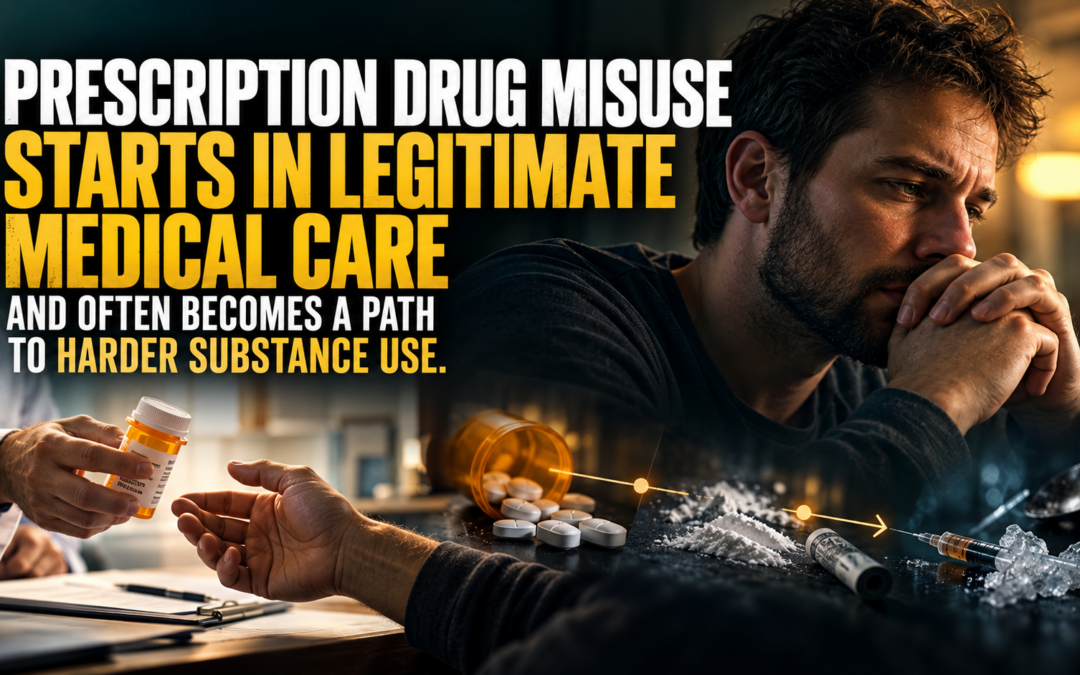
Prescription drug misuse becomes a path to harder substances when access to the medication ends but the body’s need for it does not. The National Institute on Drug Abuse (NIDA) has reported that many people who use heroin first misused prescription opioids.
This shift rarely happens because someone goes looking for a stronger drug. It happens because withdrawal and cravings feel impossible to manage alone. Not everyone who experiences prescription drug misuse moves on to other substances, but the risk is real enough to take seriously.
What Happens When a Prescription Runs Out?
When a prescription runs out, a person with physical dependence may face withdrawal symptoms like pain, sweating, anxiety, nausea or poor sleep. A doctor may stop refilling, or new prescribing limits may cut the supply.
At that point, some people turn to pills from friends or online sellers. Others turn to heroin or other street drugs because they are cheaper and easier to find.
Why Does Fentanyl Raise the Risk?
Fentanyl raises the risk because counterfeit pills made to look like oxycodone, Xanax or Adderall have been found to contain it. The Drug Enforcement Administration (DEA) has publicly warned about these fake pills.
A person may believe they are taking a familiar medication when it actually contains a far stronger opioid. Keeping naloxone (an overdose reversal medication) nearby and reaching out for support are two of the most protective steps you can take.
What Are the Warning Signs of Prescription Drug Misuse?
The clearest warning sign of prescription drug misuse is needing a medication to feel normal rather than to treat the symptom it was prescribed for. When a pill becomes the way you handle stress, sleep or daily life, it deserves a closer look.
Other signs may include:
- Running out of a prescription early
- Taking higher doses or taking doses closer together than directed
- Visiting more than one doctor to get the same medication
- Crushing, chewing or snorting pills
- Feeling anxious when your supply runs low
- Mixing medication with alcohol to strengthen the effect
- Hiding use from family or your doctor
Families are often the first to notice prescription drug misuse. It can show up as mood swings, missing pills from the medicine cabinet or a loved one who seems sleepy one day and restless the next.
Noticing these signs is not a diagnosis. It is a reason to start a caring conversation and ask for an assessment.
How Does Grand Falls Treat Prescription Drug Misuse?
Grand Falls Center for Recovery treats prescription drug misuse with a full continuum of care that addresses the medication, the body’s dependence and the condition that led to the prescription. Treatment is shaped around your history, your health and your goals.
Many people were prescribed medication for a real need. That need does not disappear in recovery, so it has to be part of the plan.
Why Does Treating the Original Condition Matter?
Treating the original condition matters because untreated pain, anxiety, depression or ADHD can pull a person back toward medication misuse. Dual-diagnosis treatment brings addiction care and mental health treatment together under one coordinated team.
Care may include cognitive behavioral therapy (CBT), which helps you notice and change unhelpful thought patterns. Group therapy and relapse prevention planning round out a personalized plan.
How Does GeneSight Testing Help?
GeneSight testing helps by showing how your genetics may affect your response to certain medications. A clinician collects a simple cheek swab, and results usually return within a couple of days.
This added precision can guide safer medication choices for anxiety or depression. It can also reduce frustrating trial and error during an already difficult season.
Which Levels of Care Are Available?
Grand Falls offers several levels of care on its calm, secluded campus in Joplin, Missouri:
- Medical detox provides about a week of supervised withdrawal support with 24/7 on-site medical and support staff.
- Residential inpatient treatment offers 30 to 90 days or more of structured care away from daily triggers.
- Partial hospitalization program (PHP) delivers intensive daytime treatment with evenings at home.
- Intensive outpatient program (IOP) offers therapy several days a week as you return to work and family.
- Aftercare and alumni support helps you stay connected after formal treatment ends.
A thorough assessment helps you and your care team choose the right starting point for recovery from prescription drug misuse.
Is It Time to Reach Out for Help?
The clearest sign it is time to reach out is when a medication you once trusted now feels hard to control. You do not need every answer before making a call.
- If you take more than prescribed or run out early, an assessment can help you understand whether prescription drug misuse is part of the picture.
- If you feel sick, anxious or unable to sleep when you skip a dose, medical detox can help you stop safely.
- If you have started using pills from outside a pharmacy or street drugs, reaching out now can lower serious risks.
- If anxiety, depression or chronic pain sits underneath your use, integrated care can treat both together.
- If a family member has voiced concern, that observation is worth exploring with a caring team.
Grand Falls offers a free consultation, so you can ask questions and explore options with no pressure.
Common Questions Before Starting Treatment
Can prescription drug misuse happen if I followed my doctor’s instructions at first? Yes. Many people start exactly as directed, then develop tolerance and begin adjusting their dose on their own. This is common and does not mean you did something shameful.
Should I stop my medication on my own? No, talk with a medical provider first. Stopping opioids or benzodiazepines suddenly can cause difficult withdrawal, and benzodiazepine withdrawal can be medically dangerous. A supervised taper keeps you safer.
What if I still need help managing pain or anxiety? Your care team will plan for that. Treatment for prescription drug misuse includes safer ways to manage the original condition, such as therapy, non-addictive medications and practical coping skills.
Will my insurance cover treatment? Many insurance plans cover addiction treatment. Grand Falls can help verify your benefits during a free consultation.
Moving Forward With Hope
Prescription drug misuse often begins with a real need and a trusted prescription, so it is nothing to be ashamed of. Understanding how it happened is the first step toward changing what comes next.
With medical support, care for the condition underneath and steady guidance at every stage, a healthier path is within reach. You do not have to sort this out alone.
If you or someone you love is ready to take the next step, reach out to Grand Falls Center for Recovery today. Our compassionate team is here to listen, answer your questions and help you find care that fits your life.